


The next image illustrates the history of CA[600]. It is symmetric and isolated.

The next image illustrates the history of CA[600]. It is symmetric and isolated.


1. Lives for ever (marked by an A in the image).
2. Dies (marked by a B in the image), or
3. Proceeds through a transient which either dies or lives for ever. (marked by a C in the image).
The study focuses on immortal processes which are called process-solutions. They are known also as attractors. We shall distinguish between regular and irregular attractors. The latter are called also strange attractors. The attractors depicted here are regular. Below is an irregular (strange) attractor.
The study explores ways which drive a process into an attractor. The experiment depicts two ways:
1. Interaction of two mortal CA ends in an immortal solution. (Second from left)
2. Interaction of a mortal and an immortal CA creates two solutions. (Last process)
 Strange attractor
Click for additional information

In the second CA (B) the barrier was removed on day 90. The CA succeeded living somewhat longer and then died.
In the third CA (C) the barrier was removed on day 123. Initially the CA grew along the barrier, and when it was removed it regenerated and ultimately died.

During its interaction with the barrier the CA changed its structure and became a spore. This change was triggered by the barrier. Despite its new structure, the CA remembered its mature structure, which it regenerated after barrier removal.
Please note:
- The barrier represents here inert matter which is not incorporated by the CA. Nevertheless the CA uses it to remain alive and occasionally to mature and die a natural death.
- If the regenerating CA would have encountered a similar barrier, it would have continued living.
- Do you know of a modeling tool other than CA which might demonstrate a similar phenomenon?
Click here for additional experiments
In the following image the second CA was planted at t = 20 and distance =18. The result is an immortal chaotic CA. The graph depicts its mass accumulation (production).
Please note:
- The chaotic CA generates non chaotic and immortal progeny (attractors).
- The CA group expands indefinitely.

 The next image depicts the Lorenz attractor which does not generate non-chaotic processes. You may wonder, what is the difference between this and the previous chaotic phenomenon? Currently you lack means (tools) to distinguish between them. To me, the Lorenz attractor fails to capture (portray) chaotic phenomena of nature.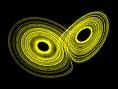

Let’s return to the previous experiment. The planted seed is the number 1 (see chapter First Steps Oct-25). When Rule = 357 is applied to the seed it will enter its subsequent state, and so on. After some time (about 40 iterations) it will die. If you plant two seeds 22 bits apart, they will soon fuse together into one CA and become immortal and start oscillating. This simple experiment illustrates the following properties of life:
1. Fertilization
2. Emergence of a new structure.
3. Symbiosis, when the two CA fuse.
4. Their fate depends on each other.
Since if one is killed before they fuse the other will die somewhat later. Without interactiong with the other it is short lived.

